
Xiaomi 17T Pro vs POCO F9 Pro in UAE (2026): Performance & Price Comparison
Miles Telecom ·
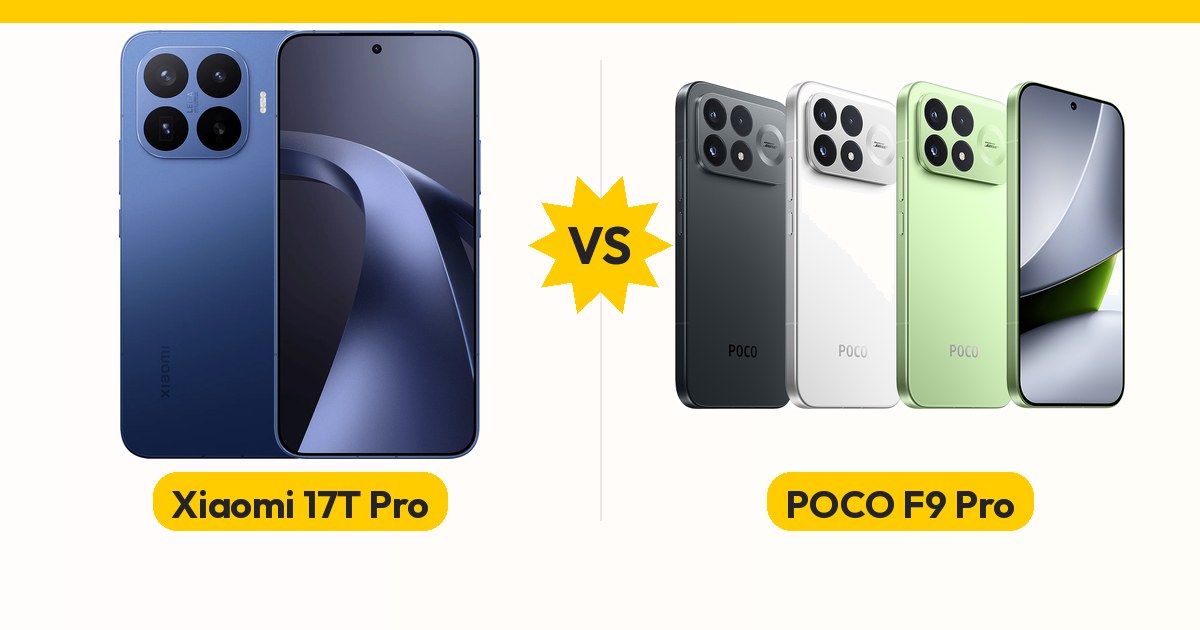
The Xiaomi 17T Pro and POCO F9 Pro divide performance shopping between a larger display and a higher refresh ceiling. Xiaomi lists 6.83 inches at 144Hz; POCO specifies 6.59 inches at up to 185Hz.
For a UAE buyer comparing the Xiaomi 17T Pro with the POCO F9 Pro, the decision centers on whether you prefer the larger 7000mAh battery and expansive canvas of the 17T Pro or the lighter, wireless-charging chassis of the F9 Pro. Choosing between Xiaomi's larger viewing area and POCO's pocket-friendly frame will matter far more day-to-day than theoretical peak benchmark scores.
UAE price in AED
Xiaomi 17T Pro
Xiaomi 17T Pro 5G 12GB 512GB Deep Blue - UAE Version (TDRA): AED 2,680
POCO F9 Pro
Want to know more about the POCO F9 Pro? Message Miles Telecom on WhatsApp.
When assessing Xiaomi 17T Pro against POCO F9 Pro, compare the storage and regional configuration as carefully as the model name. A pricing quote for an entry-level capacity will not reflect the 512GB configuration documented here for the 17T Pro. Keep the exact variant written down so that the price discussion stays tied to the device you intend to buy.
Specifications compared
| Specification | Xiaomi 17T Pro | POCO F9 Pro |
|---|---|---|
| Display | 6.83-inch, 1.5K AMOLED, 144Hz | 6.59-inch AMOLED; 2510 × 1156; up to 185Hz |
| Processor | MediaTek Dimensity 9500 | Snapdragon 8 Elite Gen 5 V Series |
| Rear Camera | 50MP + 50MP Telephoto + 12MP Ultra-Wide | 200MP main OIS + 50MP floating telephoto OIS + 8MP ultra-wide |
| Battery | 7000mAh | 6330mAh typical |
| Charging | 100W HyperCharge | 100W wired; 50W wireless |
| Operating System | Xiaomi HyperOS 3 | Xiaomi HyperOS 3 |
| Weight | Approx. 210g | 206g |
The Xiaomi 17T Pro and POCO F9 Pro entries above describe their documented configurations rather than a laboratory result. Specifically, POCO's 185Hz ceiling does not mean mobile titles will run at that speed, and 100W charging describes a peak throughput rather than an unbroken transfer rate throughout the cycle. Use these details to shortlist, then check the balance between screen size and charging convenience.
Camera
Xiaomi lists 50MP main, 50MP telephoto and 12MP ultra-wide cameras, plus a Leica 5x telephoto feature. POCO confirms a 200MP stabilized main, 50MP stabilized floating telephoto and 8MP ultra-wide. These are different tools rather than a simple total-megapixel contest.
For this Xiaomi 17T Pro versus POCO F9 Pro camera decision, bring a simple shot list: a face indoors, a wider scene and a subject farther away. Inspect the exported photo file on each screen instead of judging sharpness solely through the camera app's live stream. This reveals how Xiaomi's 50MP tuning and POCO's 200MP sensor balance dynamic range and zoom clarity under realistic shooting conditions.
Battery and charging
Xiaomi lists 7000mAh against POCO’s 6330mAh typical capacity. Both specify 100W wired charging, and POCO additionally confirms 50W wireless charging. Pick between greater listed capacity and the confirmed wireless option according to where you normally top up.
Gaming performance
Dimensity 9500 powers the Xiaomi; Snapdragon 8 Elite Gen 5 V Series powers POCO. The 17T Pro lists 3D IceLoop Cooling, while POCO documents graphics-related features. Neither feature list replaces testing the actual supported settings of your favourite game.
If your mobile routine involves extended gaming outdoors during warmer months, avoid judging either handset from a short demonstration in ideal conditions. Sustained outdoor brightness, 5G carrier handoffs, and demanding graphical presets together dictate how hard the Dimensity and Snapdragon chipsets must work. For Xiaomi 17T Pro and POCO F9 Pro, there is no verified head-to-head thermal test behind this guide, so no heat-resistance winner is claimed.
Software support
Both specifications name HyperOS 3, reducing the importance of interface branding as a differentiator. Feature availability can still vary by model and regional software. No precise model-specific update duration is established by the records used for this head-to-head.
Advantages
Xiaomi 17T Pro
Xiaomi gives you the larger screen, larger listed battery and explicitly described 5x telephoto feature.
POCO F9 Pro
POCO offers the higher maximum panel refresh rate and confirmed 50W wireless charging in a smaller screen format.
Disadvantages
Xiaomi 17T Pro
Xiaomi’s 144Hz display ceiling is below POCO’s, and its selected entry does not establish wireless charging.
POCO F9 Pro
POCO’s listed battery is smaller, and a 185Hz panel does not mean every game can use that rate.
Final buying verdict
Buy Xiaomi 17T Pro if you prefer a larger gaming canvas, more capacity and the listed 5x camera feature. Buy POCO F9 Pro if you value the smaller screen, higher refresh ceiling and wireless charging option.
Before settling on Xiaomi 17T Pro or POCO F9 Pro, ask for the exact regional version and verify the SIM setup rather than relying on a family name. Confirming official TDRA compliance ensures authorized local warranty terms and verified UAE band support over gray-market alternatives. Make the final choice around the balance between screen size and charging convenience, then confirm storage and the charging equipment you plan to use.
Related guides
- Xiaomi 17T Pro: A Bigger Canvas for Video and Games
- Xiaomi 17T Pro 5G 12GB 512GB Deep Blue - UAE Version (TDRA)
- POCO F9 Pro: What Would Make an Upgrade Worthwhile?
- Xiaomi 17T Pro 5G - UAE Version (TDRA)
- iPhone 18 Pro Max vs Samsung Galaxy S26 Ultra in UAE (2026): Which Is Better?
- Samsung Galaxy A57 5G vs Galaxy A37 5G Comparison for UAE Buyers (2026)